“Stocking Circle,” new excerpt from the novel “Pushing the River”

In the middle of the night, Kate had awakened from a sound slumber, eyes wide, face to face with the hairline crack that ran along her west wall. “Shit damn,” she thought to herself. She threw her mountain of winter covers aside and tiptoed down the stairs.

On Christmas morning, Kate found her mother in the kitchen, babysitting the coffee pot as it burbled away.

“Mama! Merry Christmas!” She threw her arms around Madeline and simultaneously said: “Don’t even think about touching that pot until it’s all done.”

“Oh for god’s sake, I do this every morning! Every morning I pour myself a cup. That’s why there is such a thing as stop-and-pour. So we don’t have to wait! So civilization can march forward!”

“It will totally ruin the rest of the pot. No touch.”

“On this of all days! It’s Christmas. Mama needs her coffee!”

Kate decided it was easier to simply place herself between her mother and the brewing pot.

“You’re a terrible human being,” Madeline said.

“Stockings first? Same as ever? Then breakfast?”

“Of course,” Madeline replied. “Same as ever. Oh, no!! Shit!!!!! I didn’t even think about a stocking for Savannah. Didn’t even enter my head! Assuming she comes out of her room. At all.”

“Of course Savannah has a stocking,” Kate said. “Santa would never forget Savannah.”

“Oh my God,” Madeline said. “Oh my god.”

“I forgot, too. Until the middle of the night.”

“What did you do?” her mother asked.

“Go look,” Kate said, while continuing: “I thought I was going to have to use one of those nasty ones you’ve kept all these years from your childhood – even though that creepy angel keeps losing more and more parts of her body like some pathetic leper – but anyway, there was a pretty new one in the box, too. Do you even remember why we got that one? I had to empty out all of the stockings, and rifle through everything, and take a little bit from everybody else’s stocking. Even my own. Sorry. Most of the stuff, though, I had to take from your stocking. Things I got for you. I think it will be OK. It’s not totally even, but I think it’ll be OK.”

“Oh my God, Kate, that’s amazing. You’re amazing.” Madeline teared up and hurtled towards Kate with outstretched arms, intending an enormous hug. But Kate took a step backwards.

“Not that I expect it will make any difference. But I thought I would try. I thought somebody should at least try.”

Hours later, when the herding of cats had at long last been accomplished, the group gathered to open their Christmas stockings. Looking around the stocking circle, Madeline began to feel as if she were in some sort of Twilight Zone improv class, a twisted parallel universe where each person had been given an exaggerated character trait that they’d been instructed to act out, and to hang onto that one trait for dear life, no matter what anyone else may be doing.

Savannah: I WILL sulk, pout, sigh, disappear at regular intervals, and broadcast dark depair.

Marie: I WILL stick with Savannah. This is blood. If she’s in despair, I’m in despair. Don’t fuck with me.

John: I WILL remain completely oblivious to anything out of the ordinary going on here. Completely. Oblivious.

Kate: I WILL HAVE A GOOD CHRISTMAS. I WILL. I WILL. I WILL.

Dan: I WILL act as if every single thing this family has created as part of their Christmas tradition is without question the most fucked up, lame assed, terrifyingly inauthentic piece of dysfunctional lunacy that I have ever witnessed in my life.

Madeline: I WILL do everything humanly possible to make sure that every one of these people is happy, happy, happy. I can do it! I can!

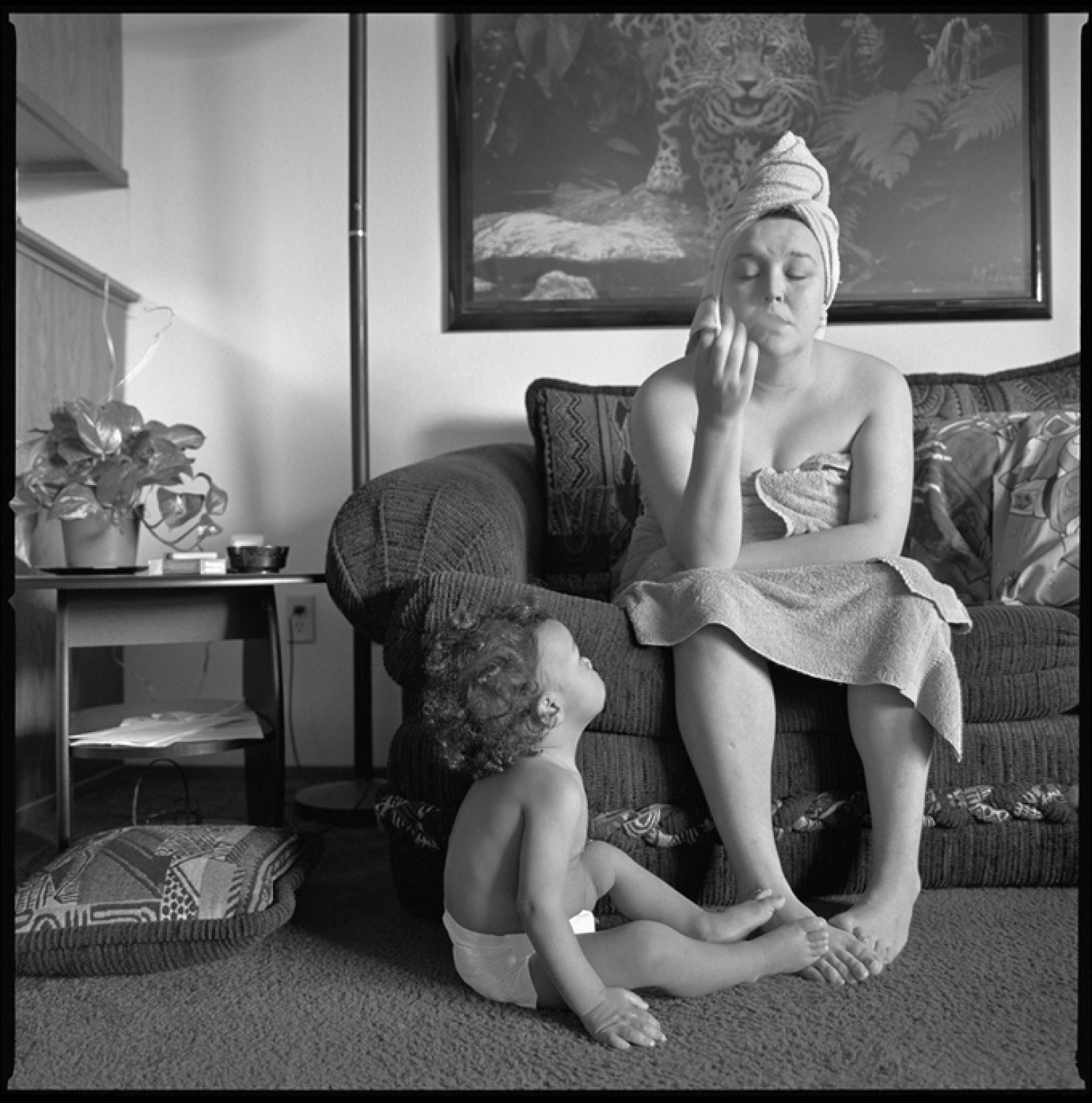
photos by Mary Ellen Mark

“Cozy, Cozy” new except from the novel “Pushing the River”

Madeline glanced over at Savannah’s face and thought: “it’s slumped. Her very face is slumped, not just her body. I did not know such a thing was possible.” Not only that, but she managed to radiate jaw-clenched, seething malcontent like waves carrying forth from a gigantic ocean liner. It was impossible to be in the room, which was quite large, and not know the intense level of her well-broadcast suffering.

Madeline’s phone rang in the other room. When she saw the name on her caller ID, she walked to the back of the house to answer. “Hi,” she said.

“Don’t tell anyone that it’s me. Please. Please, Maddie.” Billie’s voice was so soft, so nearly not there at all.

“What’s going on, Billie? How are you?”

Billie cried quietly on the other end of the line for quite a while. “I am so sorry, Maddie. So so sorry. I’ve let everybody down. Again. I’ve let everybody down again.”

“Everybody wants you here,” was Madeline’s first lie. “But everybody understands,” was her second.

Billie’s gentle crying turned to great, racking sobs; she audibly snorted the torrent of liquid that poured from her nose. “I just can’t do it. I can’t. I can’t I can’t I can’t.”

“Are you OK, Billie? Are you someplace safe?”

“I can’t I can’t I can’t. I’m so so sorry.”

“Your sister is worried about you. Can you call her? Or text her? Can you text Savannah? Wish her a good Christmas? Can you think about doing that? Try to do it before the end of the day tomorrow. Just think about it. Please just think about it, OK?”

“Don’t tell anyone I called,” Billie said, and abruptly hung up.

Madeline remained in the back room, weighing the pros and cons of keeping the call to herself. Talk about your lose-lose, she thought. Marie counted on knowing every single thing, all the time, even when the information made her infinitely more miserable.

Just then, Marie stealthed into the room and said to Madeline, “Who was that? Was that my mother?”

“I’m not sure,” Madeline replied. “Depends on: what’s the right answer to that question?”

“God damn it!” Marie said. “What did she say?”

“Not much. She doesn’t sound good. I think it’s a safe bet that we won’t be seeing her. I tried to get her to think about talking to her sister, and to Savannah.”

“Where is she? What else did she say?”

“She didn’t say much, Marie. Mostly she cried. And repeatedly apologized. Repeatedly.”

The two women looked at one another across the dark expanse of the room, saying nothing. Marie stealthed back out, leaving Madeline to gaze out at the back yard, the fat colored lights ablaze in the neighbor’s tall pine.

Right after Madeline returned to the living room and took her seat on the couch, the front door opened, and Dan came in. “Fuck, I should have known,” Madeline thought. She knew well by then that any time Dan spent with any piece of his family entailed a heavy amount of drinking on his part – plenty in their presence to manage the togetherness, and even more in the car as he drove to his next destination. A particularly tough family gathering could end up being a three-to-five-cans-in-the-car adventure. Not until he walked through the door did Madeline realize it: she had held out the hope that Christmas Eve would be different, that maybe there would be warmth and traditions and laughter and such that would have him sipping daintily at a homemade toddy instead of slugging back brew after brew.

Dan still perplexed her as a drunk. Large amounts of alcohol seemed to render him both woozy and intense. There was a coiled-snake vibe, ready at any second to strike, hard, unless he happened to slip into a peaceful stupor instead. He plopped onto the couch next to her, but sat at the very edge, so he needed to turn his head to see her. “Wow,” he said. “Look at this cozy family scene.”

“Yep,” Madeline said. “It is.” It was both a command and a plea.

“Cozy, cozy.”

center photo of F. Scott Fitzgerald and family

“Windows,” in memory of August 26, 2014, and a new except from “Pushing the River”

You have no idea, none at all, which of the most simple, everyday, completely unremarkable moments might be one that gets emblazoned in your mind for the rest of time. A snapshot of an instant, a place in your life that remains in exceptional, vivid detail – no blurring around the edges of a picture that never fades.

The day is sultry hot, a dazzling sun in the July sky. Madeline stands at the edge of an empty room, the one they have decided will be John’s bedroom. She puts the 6-week-old baby on the built-in desk; she places a fan on one side and adjusts it so it moves from side to side, blowing on John, then turning to blow on her. John reclines in the seat that they take everywhere, the one that bounces with his slightest movement.

Two of the windows are open. They are old and have the original latches on them, covered by a hundred years’ worth of coats of paint. Madeline and Dick immediately took down the cheap, yellowed window shades that had been crumbling on all six of the room’s windows. They had laughed themselves sick when they took up the area rug, surprised that it had been left behind by the previous owners, only to discover the baffling reason – the owners had refinished the hardwood floor around the edges of the room, but not underneath the rug! In the absence of the shades, the amount of sun and light coming in the early afternoon takes her breath away. Since her childhood, she has not spent time in a home, on a second floor, with the tops of trees and the sky and the difference in light.

She stands at the edge of the room, looking out the windows. The fan is nearly silent as it turns from side to side. John moves his tiny bare foot and bounces now and then.

The tiny toes on John’s foot. The height of summer’s lush leaves on the trees.  The smell of fresh paint. She has no idea how clear the picture of all this will be, will remain, for the rest of her life.

paintings by Andrew Wyeth

“Nativity,” new from the novel “Pushing the River”

It was long past the time when Madeline made an entire village of gingerbread houses for each room of the first floor –gumdrop streets lined with gingerbread men and women, M & M rooftops with chocolate Santa’s waving from chimneys, forests of festooned trees, and front yards with cheery snowmen. Still, she thought to herself, this Christmas will not be a shit show. It can’t be.

Christmas Eve was always her favorite. The calendar wound relentlessly down to the shortest days, the barest amount of daytime to illuminate a bleak winter landscape; yet a day that seemed to stretch out with the bright promise of going on forever, as a day in the middle of July.

Dan had wandered off to spend some time with his family. Savannah had been holed up at her Aunt Carol’s with Dylan for several days, and Marie had left early in the morning to join them. The only ones in the house that morning were Madeline and her two children.

Madeline was finishing the frosting on the Christmas tree-shaped cakes that had been an unbreakable traditional for years. The tin foil pans had likely been designed for one-time-then-toss-them-away use. About twenty years ago. Each year, Madeline consulted her kids for Christmas Eve menu planning. Each year, she asked them what they wanted for dessert. With cheery over-enthusiasm, she mentioned a few yummy possibilities she’d been wanting to make for them. Even if the two of them were on the phone, Madeline could hear Kate’s face fall; she could see the tears that threatened at the corner of Kate’s eyes. Each year, Madeline babied the weary pans into a shape that reasonably resembled a Christmas tree, and filled the ever-increasing holes with scraps of aluminum foil so they had a reasonable chance of holding the batter.

Madeline hummed a medley of carols to herself as she swirled the finishing touches of bright green frosting. She imagined the conversation that was about to take place–

“OK, guys, the cakes are ready for you to decorate!”

“Come on, John!” Kate would say.

“Ah, you do both of them this year, Kate. I’m in the middle of trying to finish this (fill in the blank, critically-important thing).

“No no no no no no. Come ON! It’s your cake! Your CAKE!”

This would go on for a bit, John resisting, Kate getting increasingly filled with flustered affectionate pique.

In the end, John would create a masterpiece in a shockingly short amount of time. Kate would take her time, study, plan, go back to her work again and again for fine tuning. In the end, they would both be so pleased with their work that they would carve and gouge around their favorite bits of decoration until the last few bites at the bitter end.

Before Madeline could call out to signal her final flourishes, caught right in the transition between her humming of “Silent Night” and “O Holy Night,” the sound of Kate and John tuning up their instruments in the living room drifted in. “Yeah!!!” she said.

“Surprise!” shouted Kate. “Impromptu Christmas carol serenade!”

Madeline went into the living room with a knife full of frosting still in hand, holding it out first to Kate, then to John, as they plucked strings and turned pegs to tune.

“Let’s do ‘O Holy Night’ first cause it’s my favorite and Mom was just about to sing it,”

Kate said.

“OK,” John replied. “I don’t really know it, so you start, and I’ll come in and follow.”

“What do you mean you don’t know ‘O Holy Night?’ That’s, like, blasphemy or something.”

“Are we gonna have this conversation again?”

Madeline plopped onto the couch, happier than she could remember being in a long, long time.

“Oh man. This is the greatest. I suppose I should think about starting to get dinner ready. Did Marie give you an idea of what time she’d be back here?”

“Um, I’m not sure she’s gonna make it back for dinner,” John did his very best to sound casual, but his head remained turned and his eyes on the floor as he answered his mother.

“What?” It was nearly a whisper.

“I don’t think things are going real well there. At Aunt Carol’s. I don’t think anybody’s in a very good mood.”

“What’s going on, John?”

John sank into a chair and ran his fingers through his hair, still looking at some point on the floor, then at the ceiling as he combed his fingers through his hair a few more times and let out a big, audible puff of breath. “I guess I mean that Savannah’s really, really down, so Marie is really down, too. Because her sister is. You know?”

“What’s up with Savannah?”

“I guess she’s spent all this time out there with her aunt thinking about how it’s Dylan’s first Christmas and how important that is, and well, she’s gotten more and more convinced, every day, that her mother was going to be able to get it together and have Christmas with all of them together.”

“Oh shit.”

“Yeah,” said John.

“Shit.”

“Yeah.”

“Well, what’s happening now?” Madeline asked.

“I don’t know. Savannah just really convinced herself that her mother would be there. Every day that Savannah’s been out there, every day since she left here, I guess she’s gotten her hopes more and more wound up. Now everybody has been calling Billie all day long – they started this morning – and she hasn’t picked up. They’ve texted about a hundred times, too. Anyway, finally Uncle Bob drove down there because Carol was losing her mind not knowing what was going on with her sister. So Bob gets down there and the apartment is totally dark. No lights. No nothing.”

“Perfect,” Madeline said.

“The poor guy is walking around the outside of Billie’s apartment peering in the windows and tapping on the glass. On Christmas Eve. Anyway, when he got back home, Savannah crashed and burned. She got really, really down and went pale and handed Dylan over to Marie and hasn’t said a word since then.”

Kate looked John square in the eye and said, “Do you want to play a few more, or go decorate the cakes now?”

John met her stare, held it. “So like I said, I don’t think anybody out there is in a very good mood.”

“Seems like that would be rather an understatement,” said Madeline.

“Marie is trying to talk Savannah into packing up Dylan and coming here. But I don’t know if that’s gonna happen,” John said.

“Well, what should I do about dinner? Should I hold off starting to cook?”

“No, don’t hold off,” Kate broke in. “We told them what time dinner was going to be.”

Both Madeline and John looked at her. “It’s Christmas Eve!” Kate said. “If they make it for dinner – great. If not, they’ll be here later on.”

“Well,” Madeline said, “looks like it may be just the three of us for dinner!” Her children knew her well enough to glean the carefully-disguised elation in her voice.

“Make a lot of food anyway, Ma. Please? They might be hungry when they get here.”

If they get here,” Kate said, with unapologetic accurately.

Billie Calls Marie — new from the novel “Pushing the River”

“I saw this shit storm coming a mile away, I fucking did.

You’ve always been out to ruin my life, always, and I can’t for the life of me figure out why, you ungrateful little fuck.

Savannah and I, we don’t need your ‘help,’ we don’t need it at all, not one bit of your fucking, condescending bullshit like you are so much better than me and you have everything all figured out and we can’t possibly get along for another second without you and without your help, and you are SO FULL OF SHIT it makes me sick.

Don’t move back here Marie. No one wants you here. Savannah doesn’t want you here. I don’t want you here. We are doing just FINE on our own here, we are doing great, and she is having a healthy pregnancy and I am making sure that she takes good care of herself and I am taking care of her, and we have a PLAN and we’re getting together a lot of things for the baby and NO ONE NEEDS YOUR FUCKING HELP like you are always so sure that we do, like we can’t get along without you and your meddling fucking bullshit.

Stay the fuck away from us, Marie.”

Just a few seconds after that, Billie left a second voice mail:

“Seriously, just leave us the fuck alone. Don’t call us. Don’t move back here.”

And a third:

“You are so full of shit. You have ruined, completely ruined, my life.”

And next:

“We are doing GREAT. Savannah is doing GREAT. You lie about every single fucking thing, and you need to just LEAVE US THE FUCK ALONE. I was so happy before you ruined my life with your constant BULLSHIT and your lies, and everybody knows that when I knocked Savannah’s teeth out it was an accident, a total accident, but you won’t let anybody fucking forget about that, will you, you are determined to keep ruining my life and make me wonder what I ever did to deserve such a worthless, awful, mean daughter. A so-called daughter who keeps trying to knock me over and knock me down every time I get back on my feet and moving forward and making good things happen for myself, you’re right there, knocking me down. STAY OUT OF MY LIFE, MARIE.”

All was quiet for about twenty minutes, and then:

“STAY THE FUCK AWAY FROM ME.”

photos by Diane Arbus

A Painting of Memory

I lived in the company of ghosts. I know now that they were ghosts. But I also know that they were indeed company.

The house where the vapors lurked has 9 main rooms, not counting baths and laundry and storage and closets. Of those nine rooms, I inhabited five. I used only one of the three baths, one of the 6 closets, none of the storage areas.

A small room off the main part of the basement had clearly been designed for cold storage when the house was built in 1914. The wooden door at its entrance was at least four inches thick, the door of a vault. An ancient Frigidaire ice box still sits inside, its bottom compartment open and yawning, appearing expectant for the ice man to make his daily rounds, lugging the enormous block of ice that would keep the perishable foods cold and fresh for the next 24 hours.

The storage room has built-in shelves that run along two sides. In one corner of the shelves, the Lionel trains from my childhood lay in their original boxes. People have told me that the old boxes are often as valuable, or even more valuable, then the Lionel trains themselves. This matters not at all, as far as I’m concerned. Their value lay in the fact that playing with the trains, as they wound around our Christmas tree each year of my childhood, was the only time my father ever got down on the floor, on his hands and knees, and smiled the whole time.

On the other side of the shelves, the HO trains from my ex-husband’s childhood lay in boxes that had been neatly labeled, and packed, and shipped to us by his mother. Of his three siblings, we had been designated The Keepers of the Trains. I asked him if he wanted the trains when our marriage ended. I asked him several times. He always said yes; but he never came and got them. Eventually he moved far away, with the trains still in their neatly-packed boxes, shipped to us at great expense from his parents’ house in West Virginia.

So many things were just like this – the shards and shreds of a life gone by. Like all people who marry, we came from two separate families, and we joined together to make our own new family. I became the Keeper of the Trains, a role I chose freely, without burden or regret – because I understood that there may come a time when someone would want those trains.

I lived among closets filled with the history of others, because any of the things within them might be needed at any time. Or perhaps the rooms themselves might be needed, as they have been many, many times as my children – and several of their roommates, and friends, and significant others, and spouses – needed a place to live, to call home.

They will not need this again from me.

It is more likely, in fact, that the time could come when I am moving towards my twilight, that I might need sanctuary from them.

I rattled around a great deal of space, in case I might be needed.

In my new home, I have three closets which are not even full. Both of the train have been given to my children, and hundreds of the other things we brought from our old families and collected with our new one.

I lived in the company of ghosts. I know now that they were ghosts. But I also know that they were indeed company.

Photographs by Richard Nickel

Tragically Unhip, Tales from Logan Square

I said to my daughter, “Once I’ve been out and about in my new hood for a while, such as we are now, I begin to feel like I am inappropriately un-dyed, un-pierced, and un-inked.”

She looked around the cafe for a minute and said, “Well, not everyone is dyed.” Then she added, as if this were sure to make me feel better somehow, “but everyone is also about 30 years younger than you are.”

I have done it. I have gotten myself moved out of my home of 32 years in the suburb/small town/social experiment by the lake known as Evanston; and I have relocated to a lovely apartment in the Logan Square neighborhood of Chicago. The move was, and still is, a roller coaster combination of wrenching myself away and fleeing with unfettered glee. I said to my friend the other day: “it’s kind of like when you break up with someone after a long-term relationship, and you know that person is totally not right for you. So even though you don’t miss them, there are things that you miss about being in a relationship.

I have begun a new relationship, and feel all the thrill and trepidation and mystery and hope that entails. Here’s the thing: Logan Square does indeed have its share of hipsters, meaning street corners filled with plaid shirts, one pant leg rolled up, huge sunglasses, ink sleeves, ink calves, top knots, and forgodssake, little babies in strollers wearing fedora hats. I am an open-minded and tolerant person, but that is just wrong. Babies are supposed to wear giant, floppy, silly sunhats while they are still too young to protest, not giant sunglasses and fucking fedoras.

Another thing that requires an adjustment on my part is the beard situation. A high percentage of men walking around are sporting extremely long, scraggly, Duck-Dynasty worthy facial hair. In other words, they look very much like my son did when he walked out of the woods and into my sobbing arms after his 5-month backpacking trip on the Appalachian Trail. His sister, who hiked the Trail with him, looked fit and pink-cheeked and aglow with good health. My son, on the other hand, was doing an outstanding impression of a starving, homeless person – an impression that was greatly enhanced by the beard and the fact that mice had been chewing holes in his stocking cap, not to mention his frightening thinness.

It required a great deal of will to restrain myself from my desire to force feed him continually for the next couple of months while he returned to his normal size. Anyway, this is a problem now because I’ve clearly developed a weird association in my mind between long, scraggly beards and starving. I know it’s not cool when I run into my next-door neighbor (on his bike, all inked up, beard wafting in the breeze) and mention to him that I just got back from the grocery store if he’d like me to dig out a few cookies.

I, as it turns out, am tragically unhip.

Three More Nights

When my marriage of twenty-one years came to the death throes of its legal ending, I scrimped and saved for a new mattress. This morning, nearly fifteen years later, I lay in bed until the unheard-of time of 7:30. I will sleep on that mattress only three more nights. It is long past its useful life; a new one sits in a box downstairs. I will instruct the movers to leave the old one behind, to be hauled away. The one in the unopened box will be driven to my new home on Thursday, set up in my new bedroom, and made ready for me to lay down my head at the end of the day when I will move from my home of thirty-two years.

I took out a lease on my new apartment nearly a month ago. Each week I visit it, at least once. I walk through the rooms and plan my furniture arrangements. I take measurements here and there, but I never write them down and don’t remember them later. Often I simply stand in each of the rooms, one at a time, and drink in the quality of the sound. Filmmakers always record this: the sound quality in each room when no one is speaking and nothing is happening, because each room is completely unique.

Sometimes when I walk into my empty apartment, I hate it. What was I thinking? I ask myself. I want to fall on the floor and cry. I go through machinations in my head to determine if it’s too late to change my mind. Other times I walk in and I am nearly overwhelmed with the lovely, homey charm that told me this assortment of rooms could be a home, a real and true home, for me.

I lay on my old mattress this morning listening to a rain so gentle, I had to work to hear the fine drops land. I listened to the birds’ joyful songs, the ridiculously loud ones and the more restrained, for a very long time.

I walked through the door of this dearly-loved house with a new baby in my arms and the entire life of a family ahead of me. After thirty-two years, there are many times when I ask myself if my body will know how to breathe in a different place, if my eyes will cease to see, to make sense of things, when the views out my windows are entirely foreign and not the views have been a constant through the whole arc of a life lived.

In three nights, a new chapter begins.

Soul-Killing, Radical Revision

I’ll tell you what sucks.  What sucks is when an idea for a 3rd novel that gelled a couple of years ago around the idea of a highly unusual narrator — in the form of a crotchety, dying BOILER in an old house — suddenly strikes you as an idea that won’t work.  An idea that has gotten in the way of the story, rather than providing a lovely way to bear witness to the events, and relay them with a unique point of view.  THAT’s what sucks.

And,  what sucks even more is the realization that aforementioned novel is more than half completed.  Let’s say 2/3 to 3/4 completed.  With the wrong narrator.  And thus, now needs to be completely re-written.

I hate re-writing more than most.  One of the best moments of my life was when I read an interview with author Ethan Canin in which he said that he tried to do as little rewriting as he possibly could.  He poured everything into his first draft, and felt rewriting generally lost some of the narrative drive and force of the original.  I embraced his words like gospel.

Sigh.  Nonetheless, I have now revised about 12 of the original chapters.  I have at least 18 more to go.  My organizational skills are such that various files are stored in 2 different computers, in a wide array of files.  In other words, it could be way more than 18 additional chapters.

Some of the stuff needs to be tossed away entirely (ouch!!).  Other parts can, and will, be incorporated into the story fairly easily.  In the section below, I did exactly this, and I think it worked.  A snippet that was originally told by the boiler has been woven into an existing chapter.

Even when our souls are impaled, we must gather force and go on.  I guess.

Savannah is lounging around on the couch, her belly getting so swelled up it no longer looks like it could possibly belong to the rest of her body. She’s wearing a raggedy old pair of sweatpants that she borrowed from Madeline, a T-shirt she borrowed from her sister, and a giant sweatshirt she took right off John’s pile of laundry while it was still sitting on top of the dryer. That girl dearly loves to wear everybody else’s clothes.

The television set is on, as it always is, but Savannah isn’t really looking at it. It seemed as if she mostly liked to push the buttons every so often, make the sound go up or down, or switch to a different channel she would also not watch, then go right back to pushing the buttons on her phone.

Savannah holds the phone to her ear and says, “Daddy? Hi. Hey, what do you think I should have for lunch?”

Oh my god, Madeline thinks. You have got to be fucking kidding me. Not this food thing again.

“Cereal. I had a big bowl of cereal for breakfast.”

“No. I only like creamy peanut butter, and right now all we got is the crunchy kind. I hate that stuff. Plus I only really like peanut butter with marshmallow fluff, and pretty sure we don’t have any of that either. What else?”

“No, I’ve had bagels every day cause Marie always brings them home. Plus that’s what you said yesterday. What else?”

Madeline comes in with a big basket of laundry and sits at the far end of the sofa to fold it. Savannah puts her teeny feet in Madeline’s lap and goes on with her phone talk. The little-ness of Savannah’s feet, the childlike tone of her voice – Madeline is not sure exactly what it is – she finds herself sitting on that same couch, years earlier, watching her daughter. There was a period when Kate was four and five when she would watch the same movie over and over again, and then watch it some more after that. Her first great love was “Ghostbusters,” til everyone thought they would lose their grip if they heard that tune and heard those folks saying “who you gonna call” one more time. But just when Madeline thought she might end up a few bricks shy of a load as a permanent condition, Kate switched to “The Little Mermaid.”

Kate did not simply watch. She was totally immersed. She had a whole set of costumes and dress-up clothes and pretend furs and pink plastic shoes that she would line up all across the floor, and she would stop the show between every different scene so she could put on the proper costume. She sang every song and acted out the entire story out as well. By the time the Mermaid married the Prince, Kate was wearing a pink gown with gold stars all over it and a shiny silver crown on her head. She puckered up her lips and leaned her head way out to give her Prince a sweet pretend kiss. Madeline saw all of this as she sat on the couch folding laundry.

She thought this: there was a time when she watched those movies with Kate, and she saw them through Kate’s eyes – at first, they were brand new, and every single thing you’re seeing is a wonder and a miracle, then they’re familiar enough to feel like home, but still funny enough that you get surprised – every time –cause you keep seeing all kind of things you didn’t see before, to where you think the jig is up if you have to sit in the presence of those same words for another minute of your lifetime. Quite a bit like life, Madeline thinks.

When Savannah pushes the button that abruptly ends her call, she says, “That was my dad. I was asking him what I should have for lunch.”

“Your dad?”

“Uh-huh.”

“Your father?”

“Uh-huh.”

“You were asking your father what you should have for lunch.”

Savannah can see that it ain’t a question, so she don’t answer.

“Your father, as in, the guy who put you on an airplane the minute he found out you were pregnant? Who said that you were dead to him? That father?”

“Uh-huh. He wasn’t a very big help. MadMad, what do you think I should have for lunch?”

“Oh, no. No, no. I’m not playing that game again.”

This advertisement comes on the television just then. There’s all these people setting around a table, completely frozen in time. One of them is caught right in the middle of spilling a whole pitcher of water. The first drop is just about to hit. Another is hanging in mid-air, kicking up his heels, his hair standing straight up in all directions. He is at the highest point, held in the split second before he starts on down. Yet another is tipping his chair so far back you know he’s about to tumble over backwards; but he’s caught right at the tipping point, held right there in the balance. There’s one more person. The only one who can move. He gets to walk all around this whole frozen scene, check it from every angle, ponder on exactly what’s going to happen next. He can take all the time in the world to figure it.

Runaway Train: new from “Pushing the River”

Marie is poking at a few hundred cloves of garlic she is roasting in the oven when Madeline comes into the kitchen.

“Are you mad at me?” Madeline asks her.

“No,” Marie says, in a tone of voice which successfully imparts the following: “I’ve considered whether I should be angry at you; and whether I really am angry at you but am fooling myself into thinking that I’m not; and whether I have a lot of very complicated feelings but none of them seems to be anger. So – no.”

“Is your sister mad at me?”

Marie pokes at the garlic. “You know, Madeline, everyone has told Savannah her whole entire life that she can’t do stuff. That she’s not good enough.”

“I know.”

“She’s been made to feel like such a piece of shit. From day one. Bounced back and forth.”

“I know,” says Madeline, feeling like a piece of shit.

“It felt like more-of-same to her. Like you’re just one more person who’s telling her that she’s a total fuck up. That this is yet another thing that she can’t do.”

Madeline considers for a moment just how much Marie is talking about her sister. “But she can’t do it right, Marie. Not because she’s a bad human being. Because she’s fifteen. Because no fifteen-year-old can do this.”

“She really really believes that she can.”

“I completely agree that she really really believes that she can. I agree that she really really wants to. With all her heart. She believes that this baby will land in her arms, and she will magically be able to give him every single thing that he may ever need in his whole entire life – that’s what I know she wishes. But she is fifteen fucking years old.”

“Well I for one am going to do everything I possibly can to help her.”

“Runaway train never going back/Wrong way on a one way track” – that’s what lurches through Madeline’s mind as Marie says those words. Great, she thinks; on top of everything else, fucking Soul Asylum stuck in my head.

“And I think we should all be completely committed to that,” Marie adds. “All of us. To help her as much as we can.”

“There isn’t enough help in the whole world, Marie, not enough to make this work.”

Photos from the film “Stand by Me” (top and middle)

from the film “Lone Ranger” (bottom)

Exit mobile version
%%footer%%